734-405-7500


At Kingsley Senior Living, we recognize how common sleep issues are in dementia patients. Nobody sees the toll it takes on the whole family to help a sleep-deprived loved one sleep at night or stay engaged during the day. Yes, you’ve read that right. Dementia sleep issues aren’t just about sleep deprivation but sleeping too much, too. The exhaustion families often don’t see happens at 3 a.m. and often becomes noticeable when almost the entire family starts experiencing sleep deprivation while managing a loved one’s dementia and sleep problems.
But what exactly causes insomnia in dementia patients? How are naps and dementia connected? What causes nighttime wandering? How do we build sleep hygiene for seniors? What counts as a safe sleep environment for someone with dementia? These are probably the most common questions families ask when they’re looking for an effective solution. Beyond these questions, they wonder whether professional dementia care is needed.
This blog is for families feeling overwhelmed by the challenges of managing increasingly difficult nights due to their loved one’s sleep issues. We’ll cover details about what day-night reversal in dementia is, what causes circadian rhythm disruption, and what night waking in dementia is. This sleep-science survival guide will also cover the challenges caregivers face and how memory care communities can be a reliable care option.
How Dementia Rewires The Body Clock
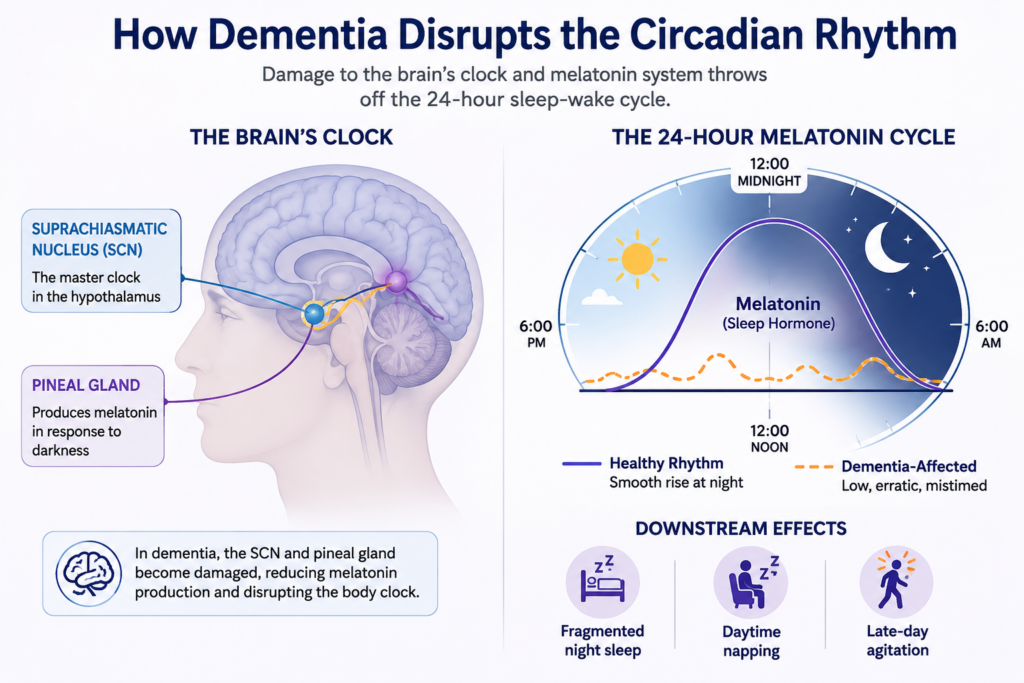
To understand why dementia patients stay up all night, you first need to know what disrupts their sleep. Sleep disruption happens because dementia rewires the body clock. Dementia damages the brain’s master internal clock (the suprachiasmatic nucleus in the hypothalamus), affects daily rest-activity rhythms, reduces melatonin production, and traps the brain in fragmented sleep cycles.
Damage to the suprachiasmatic nucleus occurs as neurodegeneration directly harms the region of the brain that handles 24-hour biological processes. The pineal gland produces less melatonin and secretes it at erratic times. It eventually loses the cue to secrete at night. These misaligned internal signals trigger late-afternoon and evening confusion, agitation, and restlessness. When nighttime sleep breaks into short, restless intervals, it leads to heavy daytime napping and mixed day-night cycles.
Too Much Sleep Vs. Too Little: What Each Pattern Means
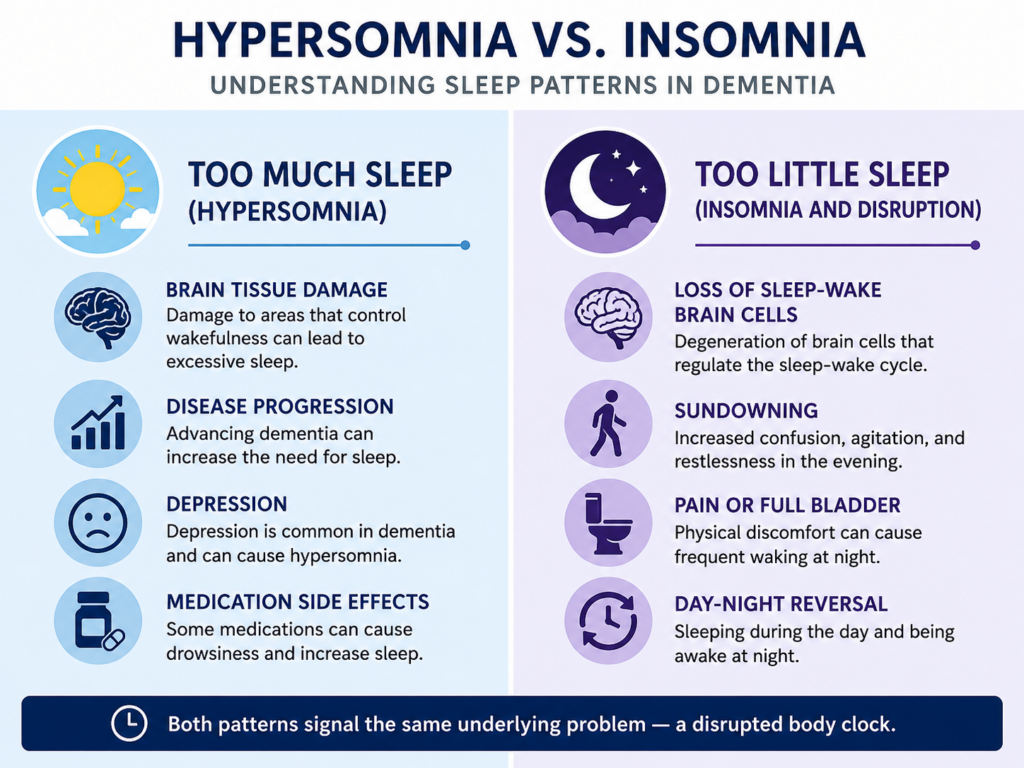
Whether it’s a lack of sleep (insomnia and disruption) or sleeping too much (hypersomnia), both show an irregularity. Dementia’s progression heavily changes a person’s sleep patterns. Here’s a brief overview of what each pattern means:
Too Much Sleep (Hypersomnia)
Sleeping more than necessary, especially during the day, can happen for many reasons. Possible causes include significant damage to brain tissue that makes the body feel constantly tired. Disease progression itself can cause people to sleep most of the day. Those experiencing depression can remain in a low mood that causes them to stay in bed most of the day. Hypersomnia can also be caused by the side effects of drugs that are used to treat behavior or mood, as they cause drowsiness.
Too Little Sleep (Insomnia and Disruption)
Insomnia and sleep disruption are usually caused by gradual loss of brain cells that control the wake-and-sleep cycle. They can become confused and agitated in the late afternoon and evening, which keeps them awake at night. Sleep disruption can also come from physical discomforts like hunger, a full bladder, or hidden pain that disrupts their rest. Damage to the brain’s master internal clock can reverse day-night rhythms, leading to nighttime wandering and daytime napping.
10 Ways To Improve Sleep, Step By Step
Promoting better sleep for someone living with dementia requires a multifaceted approach. You can’t guess your way through it and expect it to work. Likewise, no single miraculous technique guarantees results. A step-by-step routine focused on multiple strategies helps the individual get better sleep without feeling restless during the day.
Here are the top 10 effective ways a family can enhance their loved one’s sleep.
Set A Fixed Schedule
This means the individual goes to bed and wakes up at the same time every day. Predictable times lower anxiety and help them feel safe. This routine sets a steady rhythm that helps them wake up at the same time every morning and triggers natural sleepiness at night. A routine also helps reduce late-day restlessness, or sundowning.
Get Morning Sunlight
Morning sunlight is a powerful, non-pharmacological way to reset the internal body clock for individuals with dementia. The family should encourage the senior to spend at least 10 to 30 minutes outdoors in natural light within the first hour or two after waking. This simple morning routine signals wakefulness, boosts daytime alertness, and encourages better nighttime sleep.
Encourage Daytime Activity
A daytime activity doesn’t have to be an intense activity. It’s simply about keeping the loved one busy with bright lights, walks, and fun, easy tasks. But why? Or how does it help with better sleep at night? Daytime activities matter as they help burn energy, build routine, reduce stress, and uplift mood, all of which contribute to a good night’s sleep. One simple daytime activity seniors can do is a brief morning walk.
Limit Daytime Naps
No matter how groggy or sleepy the individual feels during the day, it’s the family’s duty to limit daytime naps. If necessary, a nap should be no more than an hour. Naps must not happen later in the day and should occur in the early afternoon. The reason is simple—long, late naps confuse the body clock and trick the brain into thinking it has completed sleep for the day. This eventually makes it harder for the individual to sleep at night. To limit daytime naps and keep loved ones busy, a family can encourage them to do fun tasks or take light walks.
Cut Off Caffeine And Alcohol
At least six hours before bedtime, the individual should stop consuming coffee, tea, soda, and alcohol. Caffeine in coffee will keep their brain awake and alert. Also, less fluid intake means fewer wake-ups to use the toilet. Cutting these beverages doesn’t mean they can’t have other drinks. Instead, they can have flavored water, decaffeinated drinks, or warm milk to help them relax and prevent night waking or confusion.
Adjust Evening Meals
It’s another key step towards improving sleep for people with dementia. This involves serving dinner earlier and focusing on light, easily digestible food. Limiting heavy meals helps keep the body calmer and reduces disruptions throughout the night. Consulting a dietician would help the family create a tailored meal plan that’s not just sleep-friendly but dementia-friendly, too.
Turn Off Bright Screens
Limiting the individual’s use of bright screens (phones, tablets, TVs) at least one hour before bed will prevent blue light from inhibiting melatonin production. This simple task would help their brain relax and reduce the chances of sleep disruption and confusion during the night. If the individual still wants light, whether to read books or while listening to music, they can be given dimming lights.
Build A Wind-Down Routine
You can’t expect a person with dementia to go directly to sleep after an engaging day. They need a wind-down routine to relax before bed. Typically, this wind-down routine starts about one hour before the individual actually sleeps. To create this evening wind-down routine, turn off bright lights and loud noises. Other essentials include dimming lights, restricting blue light, playing soft music, offering them a warm drink, limiting fluids, putting on comfortable clothes, and keeping the room cool. The family should make sure all of this is done as part of a routine that helps the loved one get a good night’s sleep.
Optimize The Bedroom
The family should also consider bedroom safety as part of optimizing a loved one’s bedroom. To do this, keep the room dark, quiet, and comfortably cool. If complete darkness causes panic, they can use soft nightlights.
Treat Underlying Medical Issues
If sleep problems persist, a doctor can check for pain, restless legs, or sleep apnea. This is the most overlooked step and is key to promoting a healthy sleep routine.
Melatonin And Sleep Medications: A Careful Look
Non-pharmacological approaches do not work every time. In dementia care, sleep medications are often used as a potent solution for the disrupted circadian rhythm. While melatonin is used for circadian rhythm disruption as a milder, natural option, sedatives like benzodiazepines and antihistamines are avoided due to risks of confusion and falls. The reason why stronger prescription sleep medications aren’t prescribed for long-term use is due to their associated risk of cognitive decline or dementia symptoms.
Night Waking And Wandering: Safety First
Night waking and wandering pose a serious threat to an individual’s overall safety and security. To safeguard their well-being, a family must prioritize strong safety measures, including door alarms, motion-sensor lights, and clear pathways. They must keep the sleep environment dark and quiet, address physical discomfort, and maintain a calm, structured daytime routine for the loved one.
The Caregiver Reality: No One Can Be Awake 24/7
No matter how determined a family is to care for their loved one, they can’t stay awake 24/7 to provide reliable support. Sleepless nights lead to high caregiver stress, health risks, and burnout. Eventually, the family has to consider a professional care option.
How Memory Care Communities Handle Nights
Memory care communities combine environmental design, predictable schedules, and awake overnight staff to offer reliable support to individuals struggling with sleep issues due to dementia. Together, these strategies reduce confusion, prevent wandering, and gently guide residents back to sleep without heavy sedatives that carry significant risks.

FAQ
- Why does dementia disrupt sleep?
Dementia disrupts sleep as the disease damages the brain’s internal clock (the circadian rhythm) and decreases melatonin production, which confuses the individual about day and night.
- What is day-night reversal?
It’s the complete flip of the normal sleep-wake cycle where the individual with dementia sleeps all day deeply and stays wide awake all night. At night, they stay wide awake, often pacing, wandering, or feeling restless.
- How do you handle a dementia patient who’s up all night?
The best a family can do is stay calm and avoid arguing about the time. They should be gently guided to a safe, dimly lit area, offered a quiet distraction like soft music, and checked for basic needs like hunger, pain, or a full bladder.
- What stage of dementia has the worst sleep problems?
During the moderate to severe (middle to late) stages of dementia, a person faces the most severe and disruptive sleep problems.
- Does melatonin help dementia patients sleep?
Yes, melatonin can help some patients sleep by regulating disrupted sleep-wake cycles and reducing evening agitation.
Kingsley Senior Living – Memory Care That Promotes Whole-Person Wellness
At Kingsley Senior Living, we understand how difficult sleep issues can be for people with dementia. While it’s time to sleep and rest, families often have to work to help their loved one fall asleep. The information above covers science-backed techniques a family can use to help a loved one with dementia fall asleep and sleep soundly.
If you’re having a hard time managing a loved one’s nighttime routine, contact us at Kingsley Senior Living. As a premier memory care community, we offer residents safe, secure living spaces designed to support an engaged, lively daily life. With regular routines, a professional and trained staff, and robust care programs, we make it easy for residents to live better and sleep easier. If nights have become unsustainable, schedule a tour and learn how Kingsley’s awake overnight team keeps residents safe while families finally sleep.